

News
 Back to news
Metal 3D Printing

Introduction
Metal 3D printing is one of the most advanced technologies in precision manufacturing, enabling the production of complex parts directly from a digital file. In advanced industries such as aerospace, defense and medical, metal printing is used to manufacture components that cannot be produced using traditional methods.
What is Metal 3D Printing?
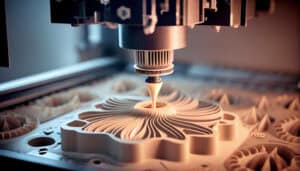
Metal 3D printing (Metal Additive Manufacturing) is an advanced industrial method for producing parts from metal powder, layer by layer. Unlike CNC machining, which removes material to shape a part, metal printing works by adding material to build the desired geometry.
The process begins with a 3D CAD file. Based on the model, the machine slices it into thin horizontal layers. A high-powered laser melts and fuses metal powder according to each layer, building the final part step by step.
This method enables exceptional precision and the creation of complex internal structures such as cooling channels and advanced geometries.
Metal 3D printing is suitable for finished products in small batches, advanced prototypes, and components for industries where performance is more critical than cost.
Types of Metal 3D Printing
The most common industrial technologies are DMLS, SLM and EBM, each suited for different needs:
DMLS (Direct Metal Laser Sintering)
Uses a laser to sinter or partially melt metal powder layer by layer. Suitable for a wide range of metal alloys. A proven and precise method.
SLM (Selective Laser Melting)
Similar to DMLS, but fully melts the powder, resulting in higher material density. Ideal for parts requiring high mechanical strength.
EBM (Electron Beam Melting)
Uses an electron beam instead of a laser. Particularly suitable for titanium and reactive materials.
Binder Jetting
A faster and lower-cost method for parts that do not require maximum density or precision.
DED (Directed Energy Deposition)
Used for repairing existing parts by adding material onto metal components.
Materials Used in Metal 3D Printing
Material selection is critical, as each alloy has different mechanical, thermal and durability properties.
Common materials include:
- Titanium (Ti-6Al-4V) – high strength-to-weight ratio, used in aerospace and medical implants
- Stainless Steel (316L, 17-4PH) – corrosion-resistant, widely used across industries
- Aluminum (AlSi10Mg) – lightweight and strong, used in automotive and aerospace
- Inconel (625, 718) – nickel-based alloy for high-temperature environments
- Cobalt-Chrome (CoCr) – wear-resistant, used in dental and orthopedic implants
- Copper (CuCrZr) – high electrical and thermal conductivity
Industrial Applications
Metal 3D printing serves industries where traditional manufacturing cannot meet requirements:
Aerospace
Air ducts, structural parts and engine components
Medical
Custom implants tailored to patient anatomy
Defense
Unique spare parts and rapid prototyping for defense systems
Semiconductors
Precision tools for manufacturing lines requiring tight tolerances
Advantages of Metal 3D Printing
Metal printing is preferred over traditional methods like CNC when high geometric complexity or low production volume is required.
Key advantages:
- Design freedom – complex internal channels and geometries
- Material efficiency – material is added only where needed
- No tooling required – no need for expensive molds
- Internal structure control – adjust density and porosity
- Cost-effective for small batches and single units
CNC machining remains the most common method for metal processing, but many projects require the unique capabilities of metal 3D printing. In many cases, both methods are combined.
How the Process Works
Metal 3D printing involves several stages:
1. Design and Simulation
Creation of a CAD model and topology optimization to reduce weight and improve performance
2. Machine Preparation
Loading fresh metal powder, calibrating the laser and ensuring an inert atmosphere (nitrogen or argon)
3. Printing
A laser builds the part layer by layer, typically 20–100 microns thick
4. Post-Processing
Heat treatment to relieve internal stress and CNC machining for high-precision areas
5. Quality Control
Industrial CT scans, penetration tests and mechanical testing according to standards such as AS9100D and ISO 13485
About Our Services
We provide metal 3D printing services for leading industries worldwide, where compliance with strict standards is essential.
Our experience in semiconductors, medical, aerospace and defense industries allows us to match each project with the right materials, technology and manufacturing partner.
We support the entire process, from CAD file to final production, including material selection, process selection, manufacturing supervision and quality control.
FAQ
What is the difference between metal 3D printing and CNC machining?
CNC machining removes material, while metal printing builds the part layer by layer. CNC is better for large production runs, while metal printing is ideal for complex geometries and small batches.
How long does it take to print a metal part?
It depends on size and complexity. Small parts can be produced within hours, while larger parts may take several days.
Is metal 3D printing suitable for mass production?
Yes, but mainly for small to medium volumes. For large-scale production, CNC or casting may be more cost-effective.
How accurate is metal 3D printing?
Typical accuracy ranges from 0.1 to 0.2 mm. With additional CNC finishing, tolerances below 0.02 mm can be achieved.
Can complex internal structures be printed?
Yes, this is one of the main advantages. Complex cooling channels and internal lattice structures are possible.
How much does it cost?
Costs depend on size, material and process, typically ranging from hundreds to thousands of dollars per part.
More News Articles